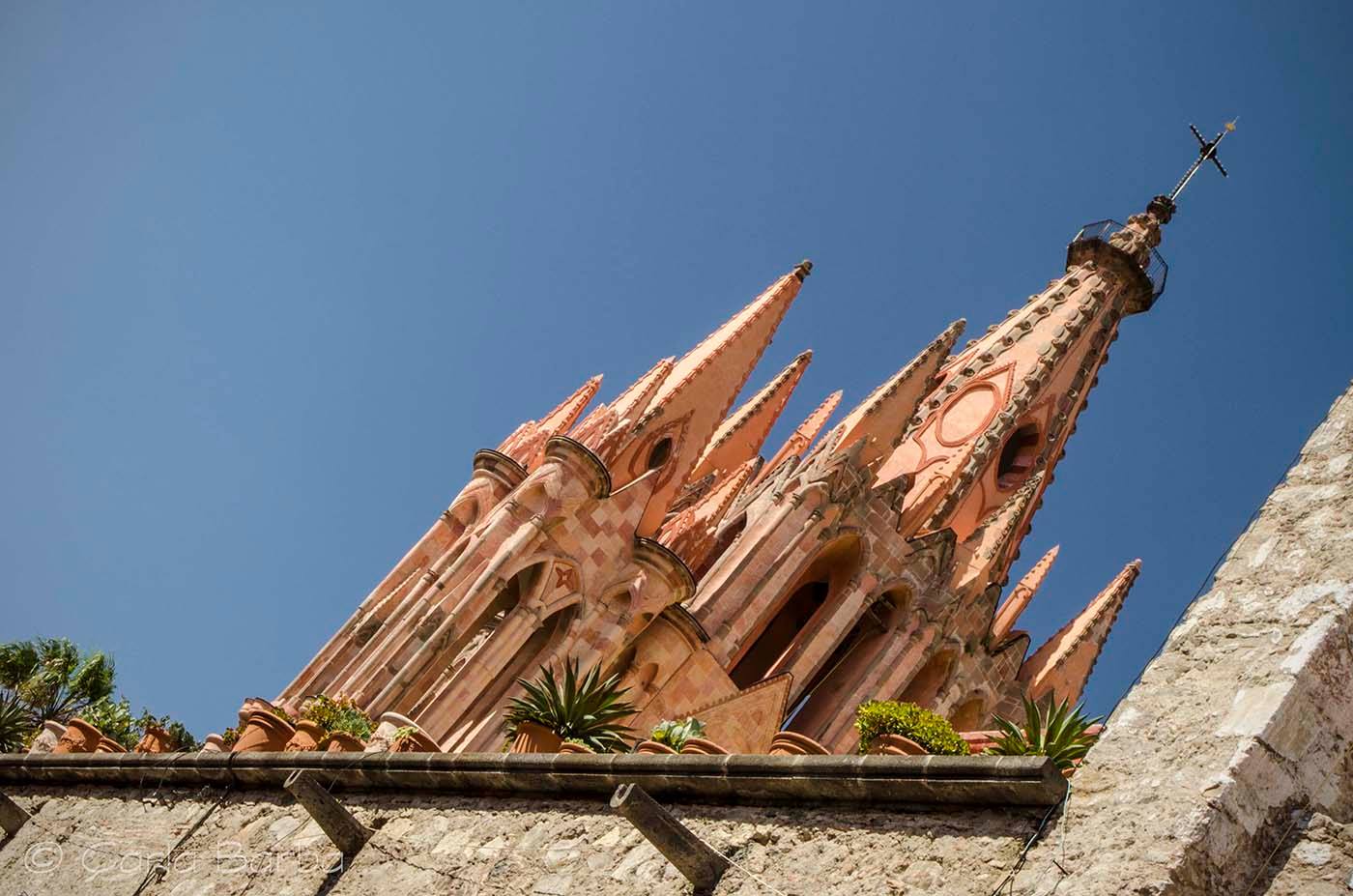
Because its towers are visible from almost any point in the city, it has become one of the most photographed parishes in the Mexican Republic.
A religious temple of Gothic and Neo-Gothic style with the status of a Parish, it is dedicated to Saint Michael the Archangel.
Located on the southern side of “Jardín Allende” (the main garden), next to what used to be the Aldama market, the Parish of Saint Michael the Archangel is a parish church built across different eras.
Parish of Saint Michael the Archangel
Mercado Ignacio Ramírez
History and construction
Originally built as a modest chapel to serve the faithful around the time Villa de San Miguel el Grande (now San Miguel de Allende) was founded in 1555, the structure suffered severe deterioration and eventually collapsed in 1649. Following this, an architectural restoration project was launched in 1680 under the direction of architect Marco Antonio Sobrarías, following the Baroque standards of the era.
By 1683, the first phase, the main body of the church was completed, though the tower and the main altarpiece were still missing. The full restoration was finalized in 1709. However, as the population grew over the years, the need for a larger and more representative church became evident.
The pink stone (cantera rosa) facade, now the primary symbol of the city, was constructed between 1880 and 1890 under the leadership of a local stonemason, Zeferino Gutiérrez. Inspired by postcards, drawings, and engravings of great medieval European cathedrals, he achieved a unique architectural style by integrating Gothic elements with indigenous essence and local traditions.
The work commissioned to Zeferino included the transformation of the facade, the niches, the choir window, the atrium, the clock bell tower, and the interior altars. In 1890, this remodeling project reached completion, cementing the church as the community’s spiritual heart and meeting point.
Today, it is not only a symbol of local identity and devotion but an international icon of the city.
Notable features that remain include a chapel designed by Francisco Eduardo Tresguerras in 1786 and the crypt, which Emperor Maximilian once described as a “tomb worthy of kings.”
Finally, the baptistery holds great national significance, as it was the site where Independence heroes Ignacio Allende and the brothers Juan and Ignacio Aldama were baptized.